High-Availability Architecture: A Beginner's Guide
Multi-region topology, VPC peering, control plane isolation, and automated failover blueprints.
Introduction
When you start working in infrastructure engineering, you'll frequently encounter terms like "high availability," "multi-region," and "failover." VibeInfra's production architecture unifies these concepts into a production-ready reference blueprint. This guide breaks down what these concepts mean and why they matter for running 24/7 cloud services.
- How VibeInfra keeps production workloads running 24/7
- Why multiple regions and availability zones (AZs) matter
- How network isolation and control plane fortresses protect workloads
- Practical Terraform blueprints and learning paths for DevOps engineers
1. Multi-Region Network Topology: The Big Picture
What Problem Are We Solving?
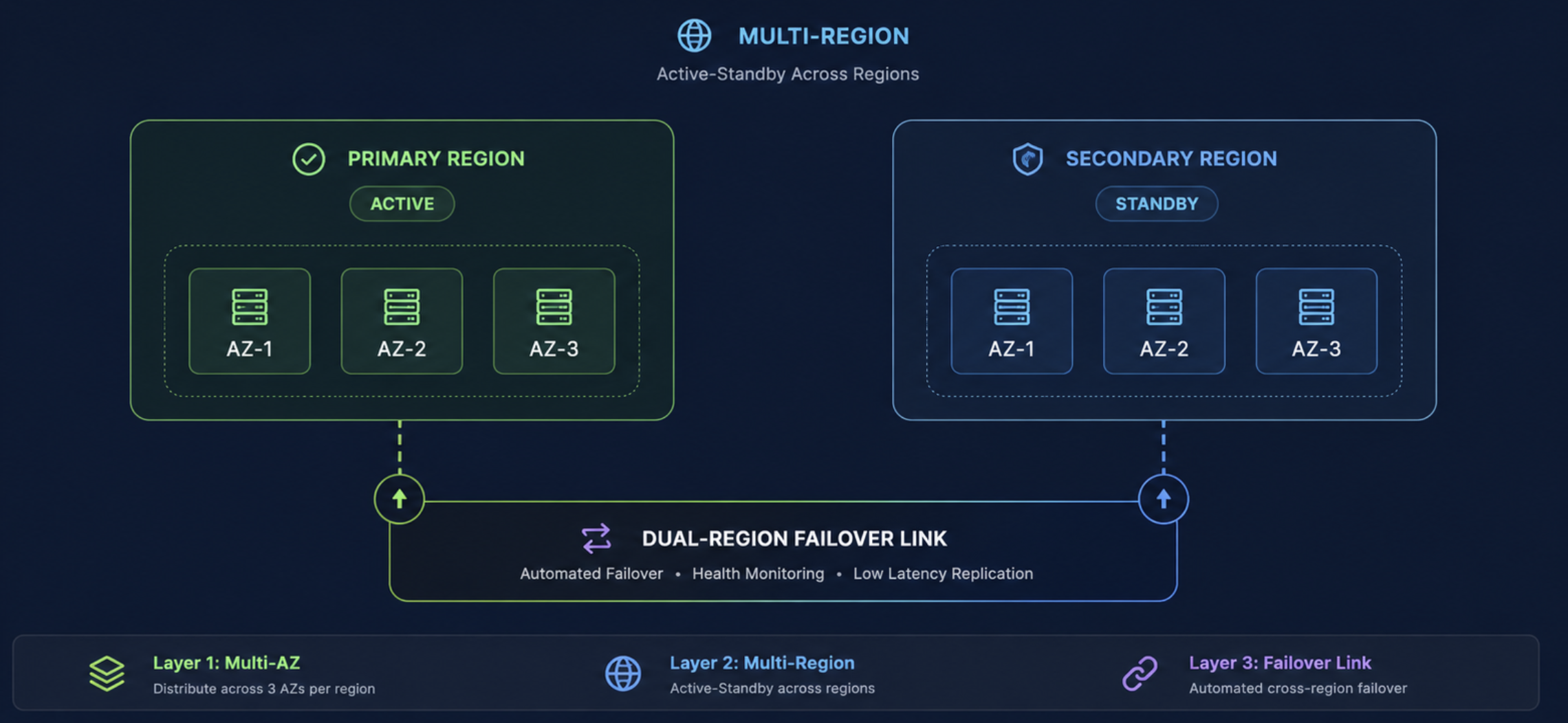
If your entire infrastructure lives in a single data center and that data center encounters a power outage or hardware failure, your entire platform goes offline. VibeInfra addresses this vulnerability with a multi-region, multi-availability zone architecture.
Breaking It Down: Regions and Availability Zones
Regions: A region is a large geographic area (such as North America, Europe, or Asia). Each region operates completely independently. If an entire region experiences an outage (e.g. grid power failure or cable cuts), other regions remain active.
Availability Zones (AZs): Within each region, multiple availability zones provide redundancy. Each AZ has independent power supplies, cooling, and network links. In VibeInfra, workloads deploy across 3 AZs within the primary region.
Why Dual-Region Failover?
- Primary Region: Handles all active production traffic under normal conditions.
- Secondary Region: Stays synchronized in standby mode, ready to take over if the primary region becomes unavailable.
- Automatic Failover: DNS and global load balancers redirect traffic automatically without manual intervention.
2. VPC Isolation: Building Network Walls
What's a VPC?
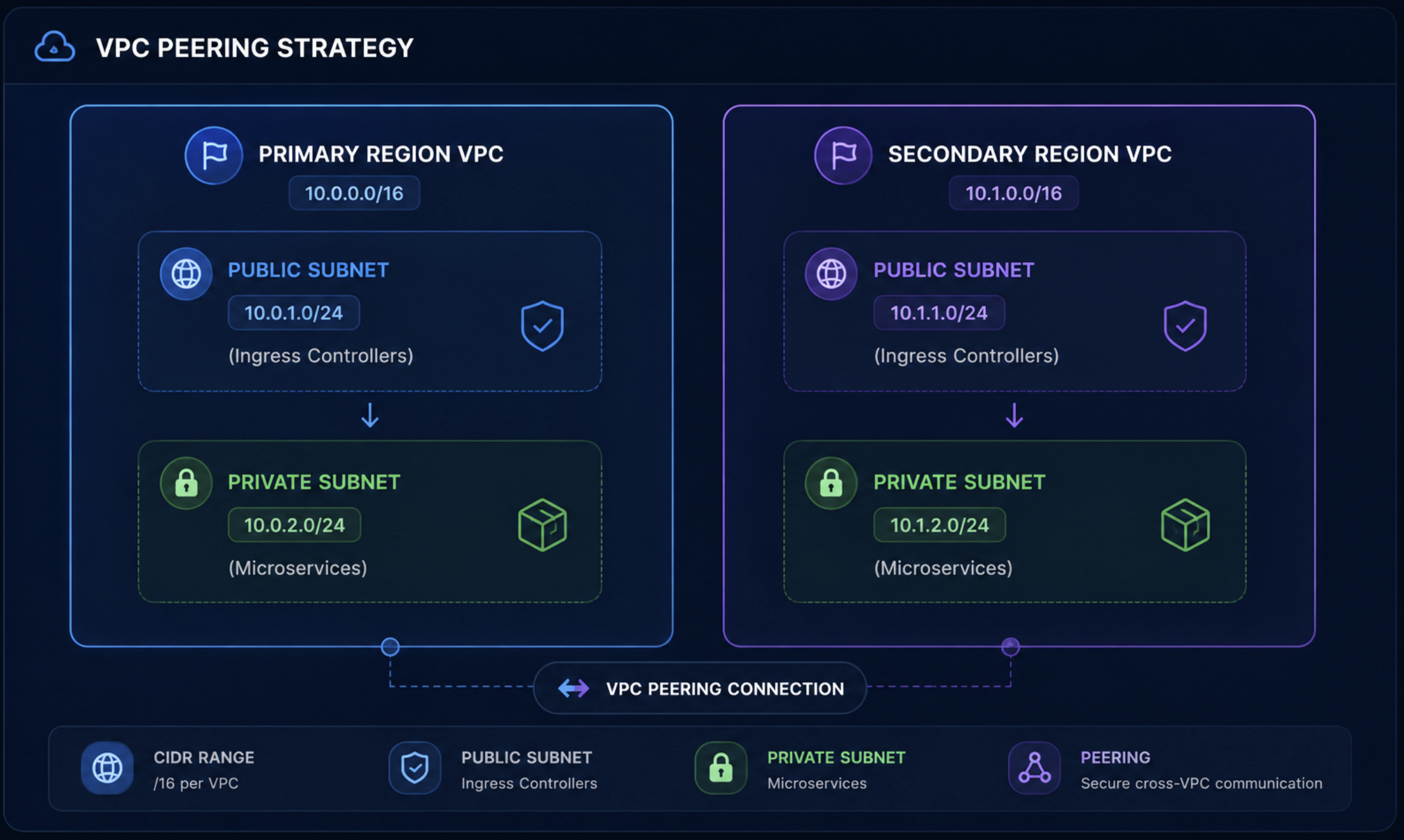
A Virtual Private Cloud (VPC) is an isolated virtual network dedicated to your cloud resources. Think of it like renting a private, locked section inside a public data center.
Public vs. Private Subnets Explained
Public Subnets: House ingress load balancers and API gateways. They have direct routing to the internet through an Internet Gateway.
Private Subnets: House core microservices, databases, and caches. They cannot be directly reached from the internet; all outbound internet traffic must route through NAT Gateways.
3. Control Plane Isolation: The Fortress Within
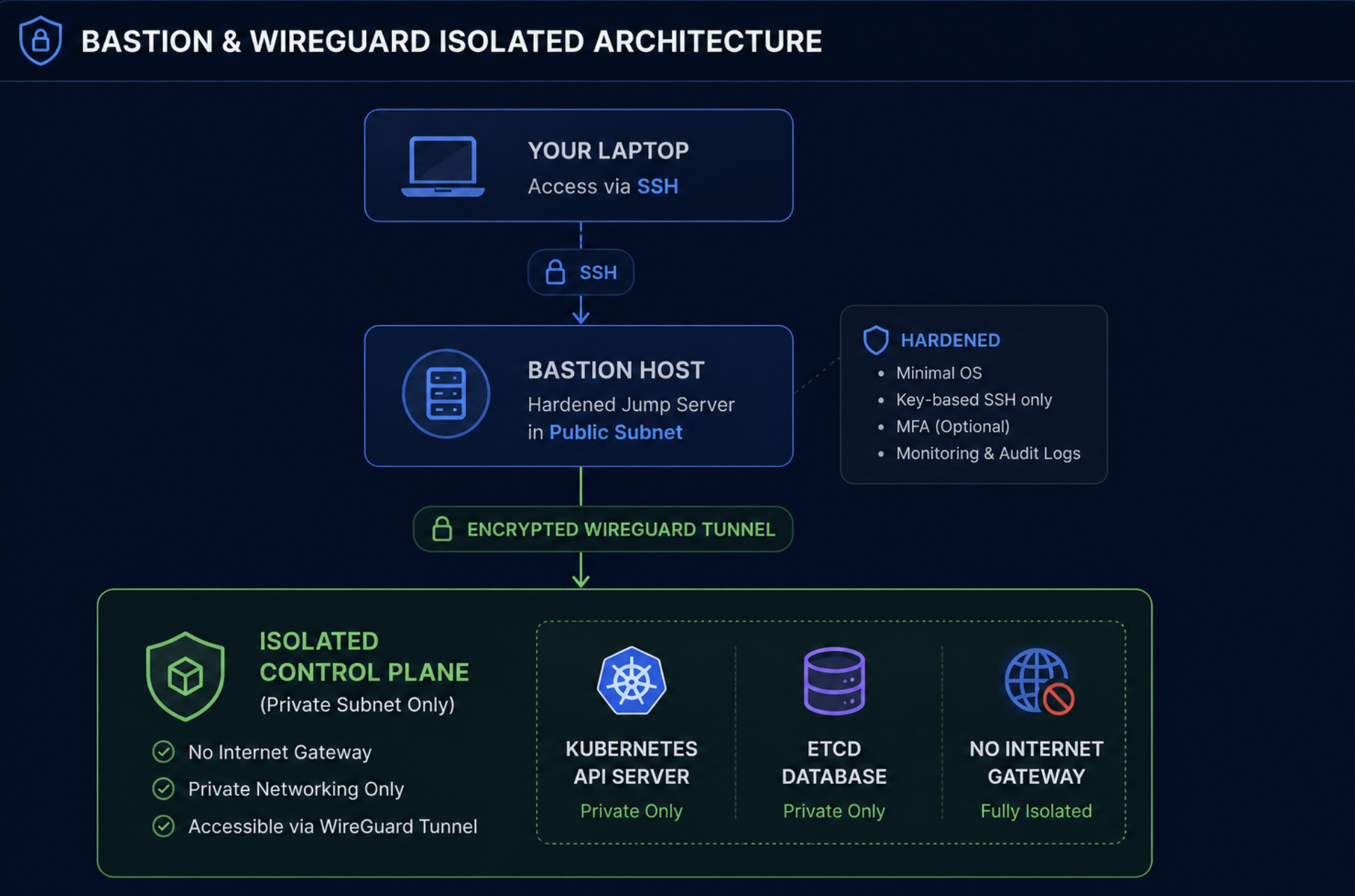
The Kubernetes control plane is the brain of your cluster, running kube-apiserver, etcd, and kube-scheduler. Gaining unauthorized access to the control plane grants full cluster control. That's why VibeInfra isolates it aggressively.
| Attack Vector | How VibeInfra Blocks It |
|---|---|
| Internet scanning for exposed Kubernetes API | Control plane ports are strictly unreachable from the internet |
| Man-in-the-middle credential theft | WireGuard end-to-end encryption prevents packet sniffing |
| Lateral movement from compromised pods | Calico network policies isolate pods from accessing control plane ports |
| Cloud provider account takeover | IAM roles with least-privilege scoping and temporal credentials |
4. Networking Deep Dive: How Traffic Actually Flows
Ingress Path (External Traffic Arriving)
- User sends HTTP/HTTPS request to your domain
- Global DNS resolves to Load Balancer in the Public Subnet
- Load Balancer inspects TLS and forwards to Ingress Controller
- Ingress Controller routes traffic through Kubernetes ClusterIP Service
- Kube-proxy delivers packet directly to targeted Pod container in Private Subnet
East-West Traffic (Service-to-Service)
Service-to-service communication stays entirely within private subnets via mTLS encryption (via Istio / Linkerd service mesh) and never touches the public internet.
5. Availability Zone Redundancy: Spreading Risk
VibeInfra distributes workloads across 3 AZs automatically using Kubernetes Pod Anti-Affinity and Pod Disruption Budgets (PDB).
Healthy State (All 3 AZs):
AZ-1: 4 Replicas  |  AZ-2: 4 Replicas  |  AZ-3: 4 Replicas  (Total: 12)

After AZ-1 Hardware Failure:
AZ-1: DOWN ❌     |  AZ-2: 4 Replicas  |  AZ-3: 4 Replicas  (Total: 8 serving traffic)

Automatic Rescheduling (< 3 minutes):
AZ-1: DOWN ❌     |  AZ-2: 6 Replicas  |  AZ-3: 6 Replicas  (Total: 12 capacity restored)
6. Database Resilience: Beyond Kubernetes
Stateful databases require explicit multi-AZ replication. Primary database instances write synchronously to an in-region standby in AZ-2, while replicating asynchronously to the secondary region.
7. Common Architecture Patterns in VibeInfra
Pattern 1: Stateless Microservices
Stateless API pods deployed across 3 AZs. Any replica can handle any incoming request. If a pod crashes, Kubernetes replaces it instantly.
Pattern 2: Stateful Workloads with Persistent Volumes
StatefulSets (e.g. Redis, Kafka, Elasticsearch) paired with AWS EBS / GCP Persistent Disks bound to specific AZs with automatic snapshot backups.
Pattern 3: Managed Database Services
AWS RDS / Cloud SQL Multi-AZ deployments managed outside Kubernetes for zero-downtime database upgrades and point-in-time recovery (PITR).
8. Disaster Recovery: Preparing for the Worst
| Metric | Target SLA | Implementation Mechanism |
|---|---|---|
| RPO (Recovery Point Objective) | < 15 Minutes | Synchronous AZ replication + 15-min async cross-region WAL logs |
| RTO (Recovery Time Objective) | < 5 Minutes | Route53 DNS health checks & automated secondary region scaling |
9. Infrastructure as Code Blueprint (Terraform)
Here is how VibeInfra defines multi-region VPCs and EKS clusters using Terraform:
# Primary Region Network Blueprint
module "primary_vpc" {
  source  = "terraform-aws-modules/vpc/aws"
  version = "~> 5.0"

  name = "vibeinfra-primary-vpc"
  cidr = "10.0.0.0/16"

  azs             = ["us-east-1a", "us-east-1b", "us-east-1c"]
  public_subnets  = ["10.0.1.0/24", "10.0.2.0/24", "10.0.3.0/24"]
  private_subnets = ["10.0.11.0/24", "10.0.12.0/24", "10.0.13.0/24"]

  enable_nat_gateway = true
  single_nat_gateway = false # High Availability: 1 NAT Gateway per AZ
}

# Cross-Region VPC Peering Connection
resource "aws_vpc_peering_connection" "cross_region" {
  vpc_id      = module.primary_vpc.vpc_id
  peer_vpc_id = module.secondary_vpc.vpc_id
  peer_region = "eu-west-1"
  auto_accept = false
}

# High-Availability EKS Cluster
module "primary_eks" {
  source          = "terraform-aws-modules/eks/aws"
  cluster_name    = "vibeinfra-primary-eks"
  cluster_version = "1.28"
  subnet_ids      = module.primary_vpc.private_subnets

  eks_managed_node_groups = {
    main = {
      min_size     = 3
      max_size     = 9
      desired_size = 3
      instance_types = ["t3.large"]
    }
  }
}